
Blog
Why is Early Detection of Turbo Failure Important?

🛠️ What is Turbo Overhaul?
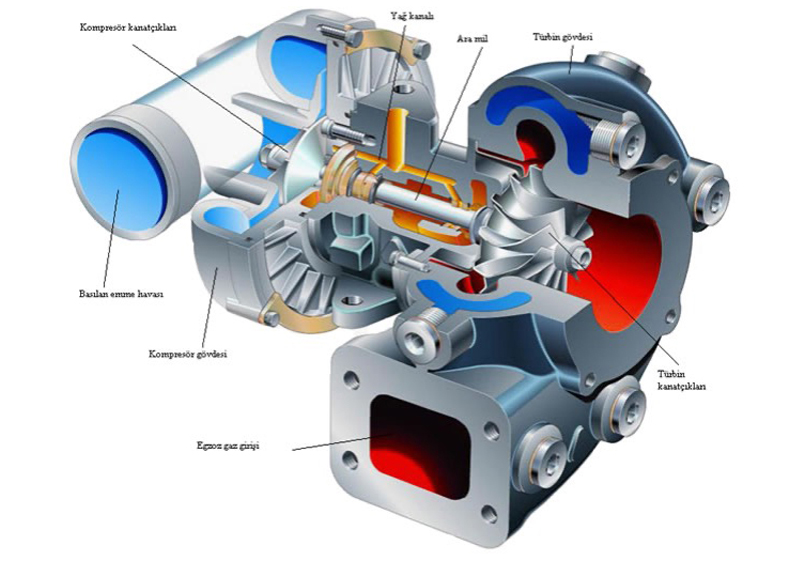
Turbocharger overhaul is the process of disassembling a non-functional or underperforming turbocharger, completely renovating it, replacing its internal parts, cleaning it, balancing it, and testing it. It is much more comprehensive than a simple fault repair. The aim is to regenerate the turbocharger and restore it to perform at the closest possible level to its factory settings.
After the revision:
* Turbo performance increases
* The engine gets stronger
* Fuel consumption decreases
• Black/blue/white smoke problems are eliminated
* The engine noise calms down
• Turbo life is extended
• Turbo lifespan is extended. With a professional overhaul, quality oil, and proper usage, it can operate smoothly for up to 100,000 km.
⚠️ Why Does the Turbo Charger Fail?
Turbocharger systems operate at between 150,000 and 250,000 revolutions per minute. Proper lubrication and operation at the correct temperature are vital for a shaft rotating at this speed.
The most common causes of turbo failure are:
🔧 1. Late oil change or use of after market oil not of the appropriate specification
🔧 2. Oil channel blockage
🔧 3. Low-quality fuel
🔧 4. DPF/EGR clogging
🔧 5. Overheating
🔧 6. High-mileage use
🔧 7. Incorrect software that increases boost (chip tuning)
🔧 8. Air filter clogging
🔧 9. Lubrication failure (leads to immediate turbo lockup)
Even one of these items can pose a serious risk to the turbocharger. Therefore, it is very important to adhere to the maintenance intervals.
🚨 How to Recognize a Turbo Failure?
When a turbocharger malfunctions, it always gives some sort of indication. Here are the most common signs:
🔥 1. Loss Of Power
If the vehicle doesn't accelerate like it used to, especially if it stalls on ramps, it means the turbo isn't producing pressure.
🔥 2. Blue, Black or White Smoke
• Blue smoke: Oil burning (turbocharger seals malfunction)
• Black smoke: Burning malfunction, low turbo pressure.
• White smoke: Water vapor or cooling issues
🔥 3. Whistling or Humming Sounds
The sound of the turbo shaft rubbing against the housing or imbalance-related noise is often similar to a whistle.
🔥 4. Fat Reduction
If the turbo is leaking oil, the internal parts may be worn out.
🔥 5. Fault Lamp
The engine warning light or turbo/boost warnings may come on.
If you experience several of these symptoms, it means it is time for a turbocharger overhaul.
🔧 How is a Turbocharger Overhaul Performed?
How to do a turbo overhaul professionally?
The following process is essential for a proper revision:
🔩 1. Removal of the Turbocharger from the Engine
• Oil inlet/outlet hoses are separated
* The intercooler pipes are removed
* Vacuum hoses are removed
* Actuator connections are separated
If attention is not paid at this stage, the turbocharger or the engine may be damaged.
🔍 2. Complete Disassembly of the Turbo Unit
The turbo is disassembled with special teams:
• Compressor impeller
* Turbine Shaft
• Main body of the center
* Repair Kits
• Rings
• VNT mechanism (if any)
* Aktuatör (Atık Kapısı)
Each part is separated for inspection.
🧪 3. Component Checks and Measurement
* Shaft curvature control
* Wing fracture or friction mark
• Repair kit tolerance measurement
* Hull crack control
* Geometric VNT soot control
Shaft and bearing surfaces are examined with micron-level precision.
🧼 4. Industrial Cleaning and Sandblasting
Professional cleaning procedures:
Ultrasonic cleaning
* Jet washing
* Sandblasting's
• Oil-carbon cleaning with chemical solvent
This step determines the difference between the new turbocharger and the old one.
🔄 5. Complete Replacement of Worn-Out Parts
The parts that changed the most in the revision:
• Beds
* Repair kit
* Oil seals
• Rings
• Compressor wheel (if necessary)
• Turbine Cartridge Katric
• VNT (variable geometry)
* Shaft (if worn)
⚙️ 6. Turbine Cartridge Assembly
The CHRA (turbocharger center section) is reassembled with brand new parts.
This track is the heart of turbo performance.
⚖️ 7. High-Speed Balancing Adjustment
Balancing is the most critical step in the overhaul process.
The turbo shaft's rotation at 150,000 to 250,000 revolutions per minute requires balance adjustment to be performed with micron-level precision.
The balancing machine we use is the Turbo Technics VSR400 (High-Speed) balancing machine.
It is ideal for the balance value to be at the minimum level below 0.5 mg/mm.
⚙️ 8. VNT (Variable Geometry) Adjustment
In VNT turbos:
* Wing angles
• Motion tolerances
* Geometric reactions
it is adjusted according to factory values.
This process cannot be performed without special devices.
🧭 9. Actuator Testing
* Electronic Actuator sensor control
• Vacuum actuator on-off test
* Pressure response measurement
If the actuator is defective, it cannot be repaired and must be replaced.
🧪 10. Leak and Pressure Tests
After the turbo was reassembled, Dec:
* Pressure test
* Oil leakage test
• VNT motion test
• The motor is made ready for installation by performing a warm-up/cool-down simulation.
✔️ Golden Rules to Extend Turbo Charger Lifespan
80% of turbo failures result from improper use and lack of maintenance.
Here are suggestions worth of gold to extend the turbo life:
⭐ Use quality engine oil and filters according to the manufacturer's specifications.
⭐ Do not delay oil change by more than 2,000 km
⭐ Do not load into the cold engine
⭐ After a long drive, wait 20-30 seconds before stopping.
⭐ Change the air filter regularly
⭐ Do not neglect intercooler cleaning.
⭐ Do not postpone DPF/EGR faults.
When you follow these rules, your turbocharger will last much longer.
At Revmer Revision Center, turbocharger repairs are performed to manufacturer standards and with a warranty.